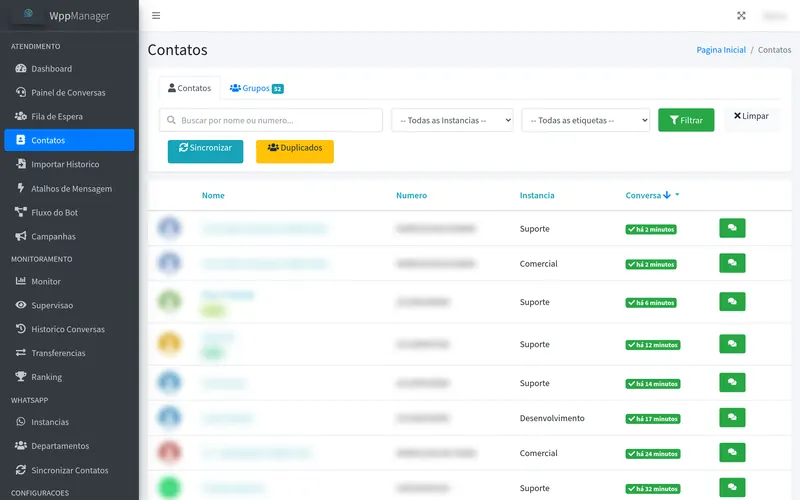
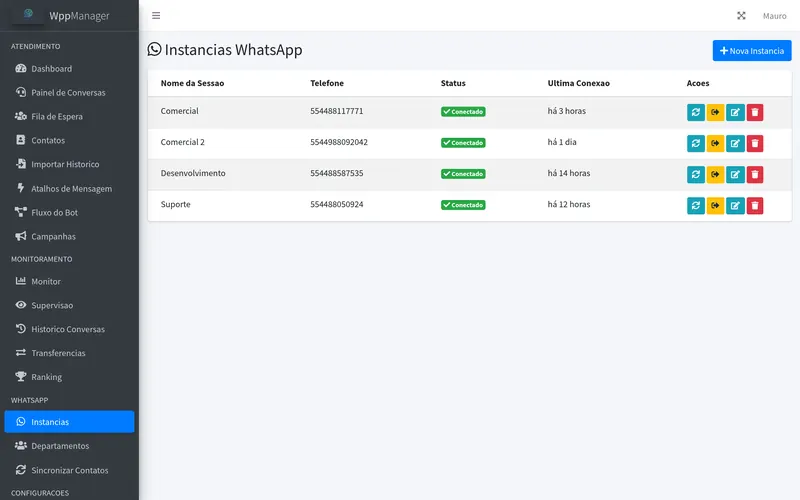
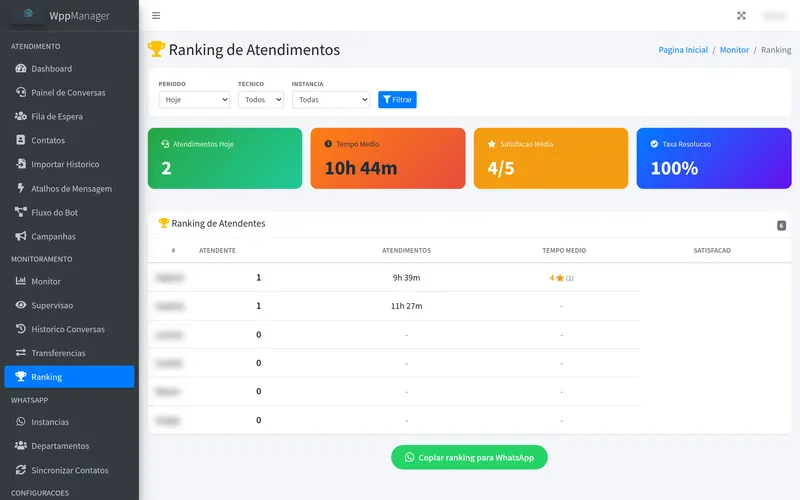
One WhatsApp number doesn't scale. One dashboard does.

Multiple numbers and multiple agents working together, with department queues, automatic routing, an after-hours bot, bulk campaigns and live supervision — and nobody has to hand their phone to a coworker.
Cloud or on your own server Multi-company API and webhooks
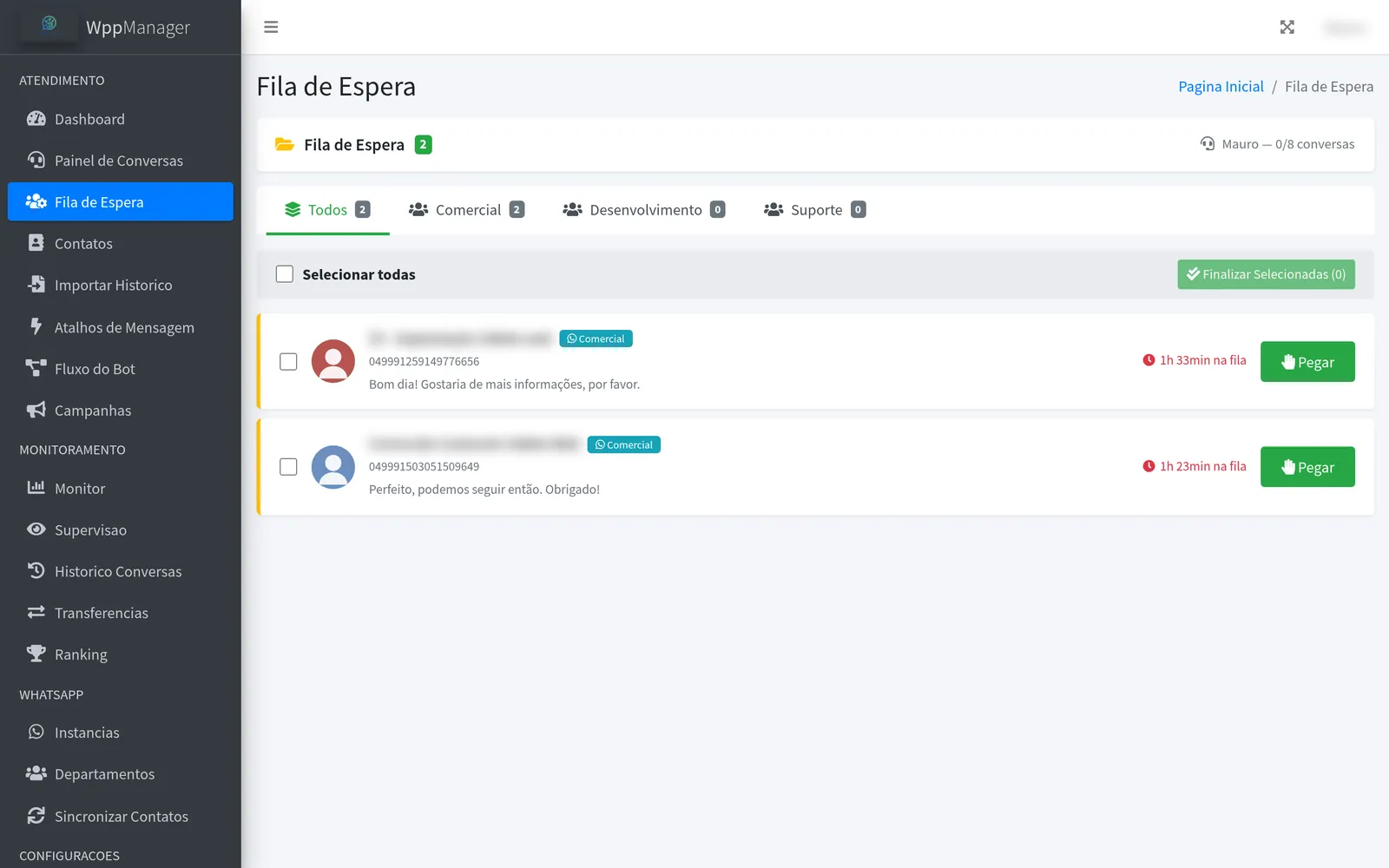
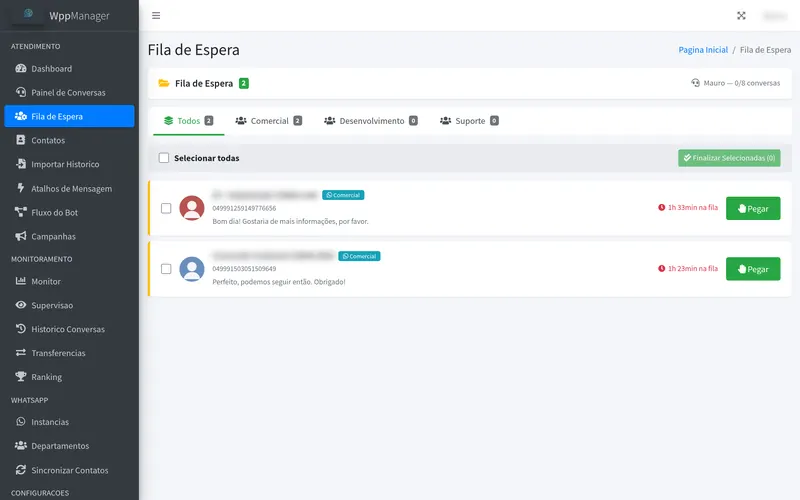
WppManager · Waiting queue
WppManager waiting queue, split by department

The problem

WhatsApp became the main channel — and it's still handled like a personal phone

Messages nobody saw, customers who told their story three times, an agent who went on vacation with the conversation on their phone. None of this is a lack of effort: it's a lack of tools.

“Who's handling this customer?”
Department queues with a live counter and wait time.
“He already told the other agent.”
Transfers carry the history along — the customer repeats nothing.
“It came in at 10 p.m. and nobody answered.”
Self-service bot and automatic after-hours message.
“How's the team doing today?”
Live monitor, agent ranking and satisfaction survey.

What's inside

Customer service, automation and campaigns in one place

Conversation hub

Several open conversations with text, images, video, audio, PDF and stickers. Quote replies, react, edit, forward and sign automatically with the agent's name.

Queues and routing

Department queues and automatic routing to the least busy agent, respecting conversation limits, status and department.

Transfers with history

Hand the conversation to another agent or another number, with a reason, accept or decline, real-time notification and a full log.

Self-service bot

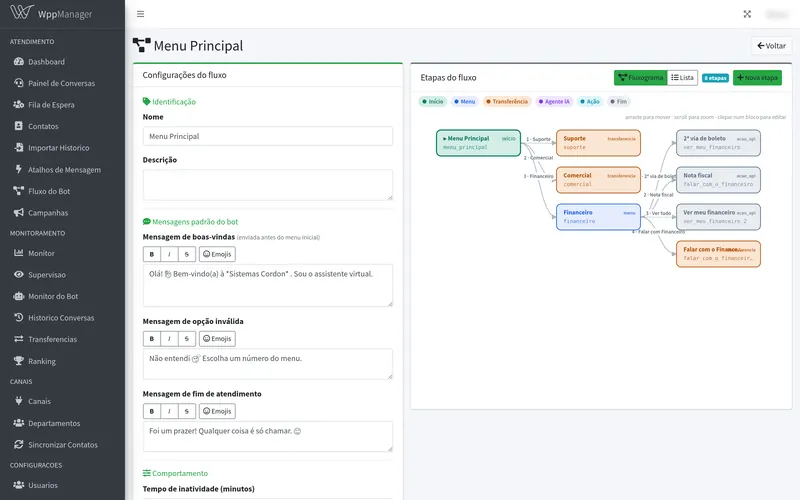
The flow is drawn as a flowchart: each step is a block, the links show where each option leads, and you click a block to edit it. Runs 24 hours a day.

Bulk campaigns

Text, image, video or PDF with variables. Scheduling, interval between sends, hourly limit and tracking of delivered, read and replied.

Monitoring and supervision

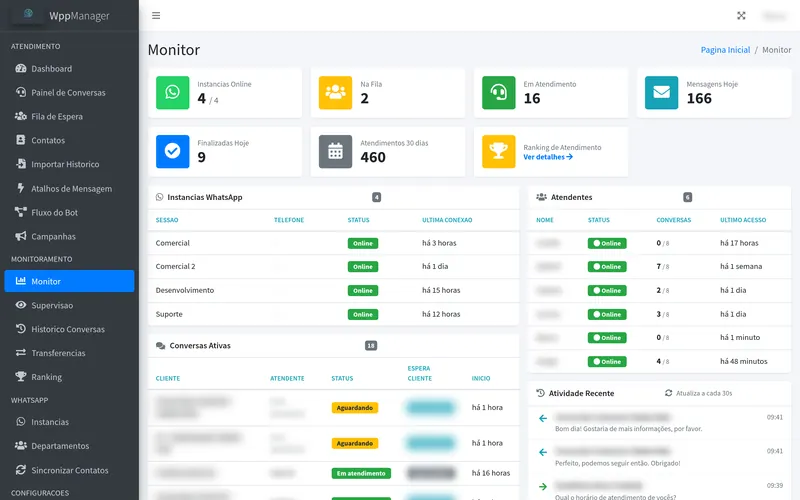
Instances, agents and conversations live. Productivity ranking, auditable history and a 1-to-5-star satisfaction survey.

Tidy contacts

CSV import with column mapping, tags, duplicate detection and merging, and creating a contact straight from the conversation.

AI that helps, not invents

An agent with your own knowledge base, reply suggestions based on the real conversation, profile and urgency reading, summaries for opening tickets and classification of campaign replies. If the answer isn't in the knowledge base, it hands off to a human.

API, webhooks and PWA

API with a per-company token to send messages and query results, webhooks and installation as a phone app with push notifications.

A channel that drops and comes back on its own

When a number's connection drops, the system tries to reconnect on its own, at spaced intervals. Only when it gives up does the alert appear — and it blocks anyone working on that number. The worst case isn't the channel going down: it's an agent spending the afternoon replying without knowing nothing is going out.

Supervision

You see the team at work, not yesterday's report

Each open conversation is a card, showing who's handling it, which department and how long the customer has been waiting — with the latest messages right there, no need to open it. It's the entire operation on one screen, as it happens. When the wait goes past what's acceptable, the card turns red: you don't have to look for the problem, it shows up.
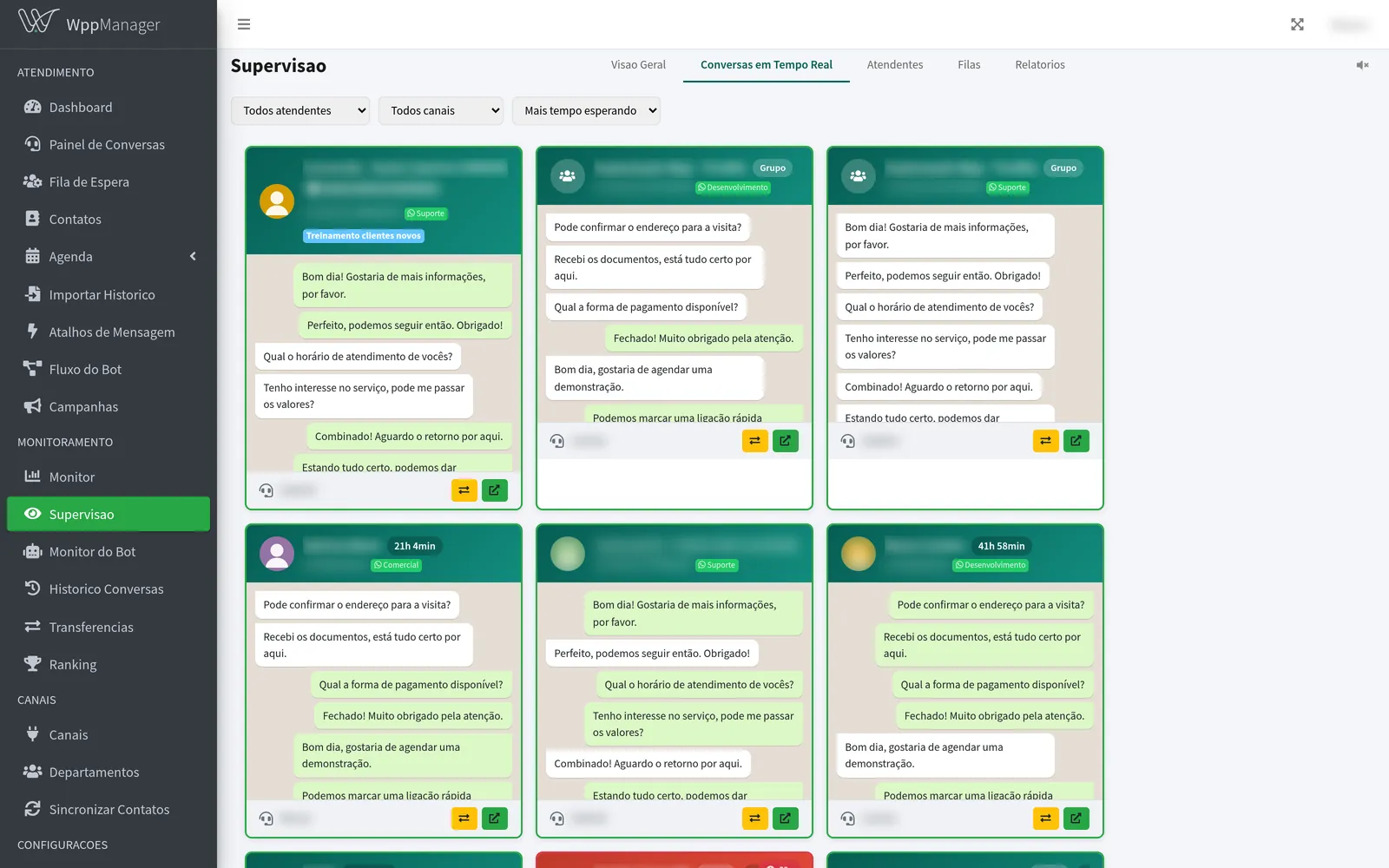
  • Filter by agent, by channel or by who has been waiting the longest.
  • From the card itself you can transfer the conversation or take it over.
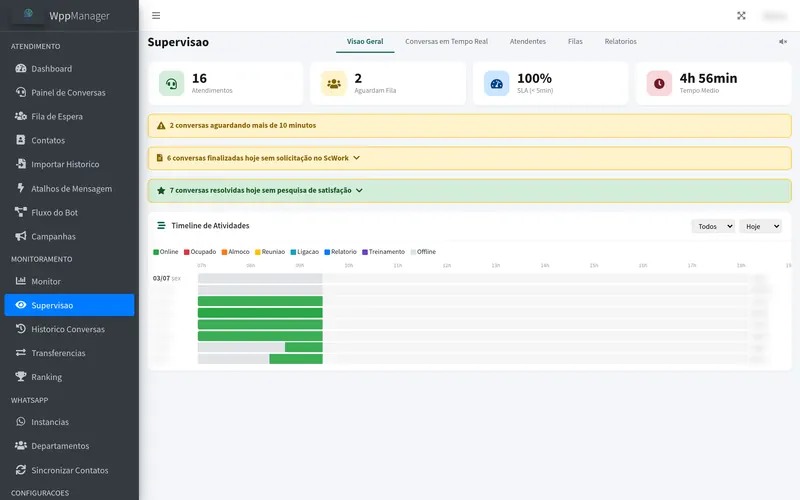
  • The Overview tab sums up the day: conversations, queue, SLA, average time and the timeline with each agent's status — the same status that drives routing.
  • Productivity ranking and a complete, auditable history of closed conversations.
/admin/supervisao
WppManager supervision tab for real-time conversations: each open conversation appears as a card in a grid, with the department, wait time and latest messages; one card is highlighted in red for a long wait, and there are filters by agent, channel and longest wait
Bot

You design the service flow, you don't code it

The flow appears as a flowchart: each step is a block colored by what it does — menu, transfer, AI agent, action — and arrows show where each customer option leads. Drag to move, scroll to zoom, click a block to edit. The person who builds the flow is the person who knows the service.

  • Action blocks talk to CdAdm and deliver the document in the chat.
  • AI agent blocks answer from the company's knowledge base.
  • Transfer blocks choose the receiving department.
  • Input and condition blocks ask something and change the path based on the answer — the city decides whether the appointment is in person or online.
  • Switch between flowchart and list view when the flow gets large.

And you can test it before customers see it. The test panel chats with the flow right there, just as a customer would — nothing is sent to anyone. You fix the wording and the path before publishing, instead of finding the mistake with a real customer.
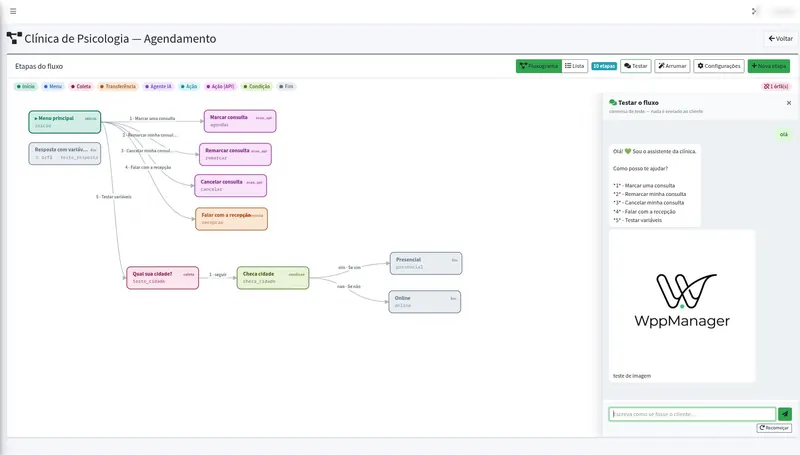
A clinic's bot flow as a flowchart, with menu, input, condition, transfer and action blocks linked by arrows; next to it, the test panel shows the bot replying with the menu to book, reschedule or cancel an appointment
Bot flow · flowchart and live test
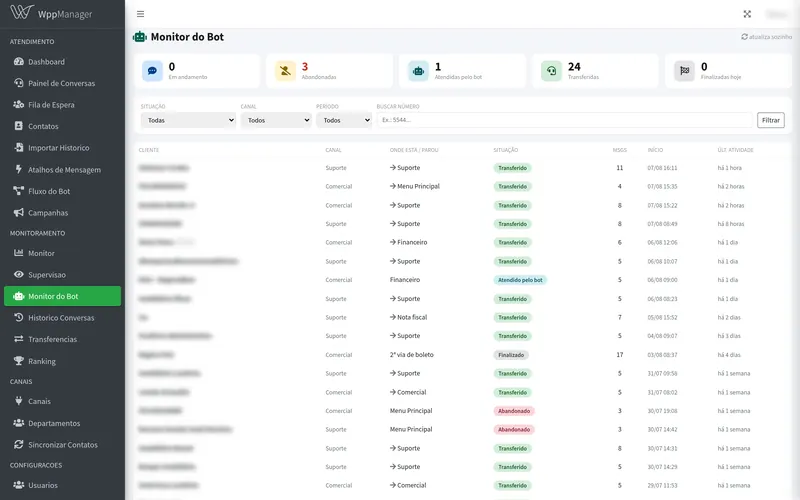
Bot Monitor: counters for conversations in progress, abandoned, handled by the bot, transferred and closed, and the list showing where each conversation stopped
Bot Monitor · where each conversation stopped
AI agent

An AI that would rather hand off to a human than make up an answer

You enter your company's information into a knowledge base — hours, payment methods, policies, FAQs. Each block is indexed when saved, and the agent answers from there.

If the information isn't in the knowledge base, the AI doesn't improvise: it hands off to an agent. That's a design choice, not a side effect — and it's what separates a useful assistant from one that makes up prices and deadlines on behalf of your company.
  • The AI reads the whole conversation, not just the last few messages.
  • After N replies without resolution (you set the number), it hands off to a person instead of insisting.
  • The Bot Monitor shows what was resolved and what was transferred, and where in the flow each conversation stopped.
  • Multiple AI providers chained — if one goes down or runs out of quota, the next one takes over.
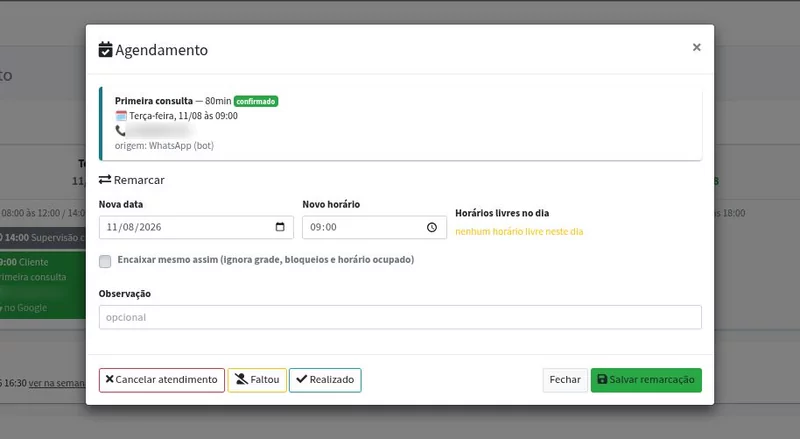
Appointment window in the WppManager calendar: an 80-minute first consultation, confirmed, Tuesday at 9:00, with source WhatsApp (bot); below, the rescheduling block with a new date, a new time, a notice that no slots are free that day, and the buttons to cancel, mark as no-show and mark as completed
Calendar · the appointment the bot booked, open in the dashboard
Calendar

The bot books on WhatsApp — and you stay in charge from the dashboard

Notice the small line in the screenshot: source: WhatsApp (bot). Nobody at the clinic typed that time. The client chatted on her usual WhatsApp — no app, no portal, no password — picked "first consultation", and the appointment was created confirmed, taking the 80 minutes that service lasts rather than a generic one-hour block.

From the same screen, the front desk handles the rest: reschedule, cancel, and record whether the patient was a no-show or the appointment was completed — which is what turns no-shows into numbers instead of memories.

  • When you change the date, the dashboard immediately shows which times are open that day — including "no free slots this day" when that's the case. It's the same math the bot uses: the schedule, minus blocked times, minus what's already booked.
  • "Fit it in anyway" ignores the schedule, blocks and booked slots. The system warns that it doesn't fit, but you make the call.
  • One calendar per professional, not one for the whole company: each with their own schedule, their own services and their own Google Calendar — the appointment shows up there automatically.
  • Booked directly in Google? That slot drops out of what the bot offers — the two sides sync both ways.
  • Minimum notice, maximum booking window and buffer between appointments are your rules. The bot's messages are edited in the dashboard, not in code.

Free slots are calculated inside WppManager itself, not in Google. That's why the answer is instant — and why booking keeps working even if the Google API is down.
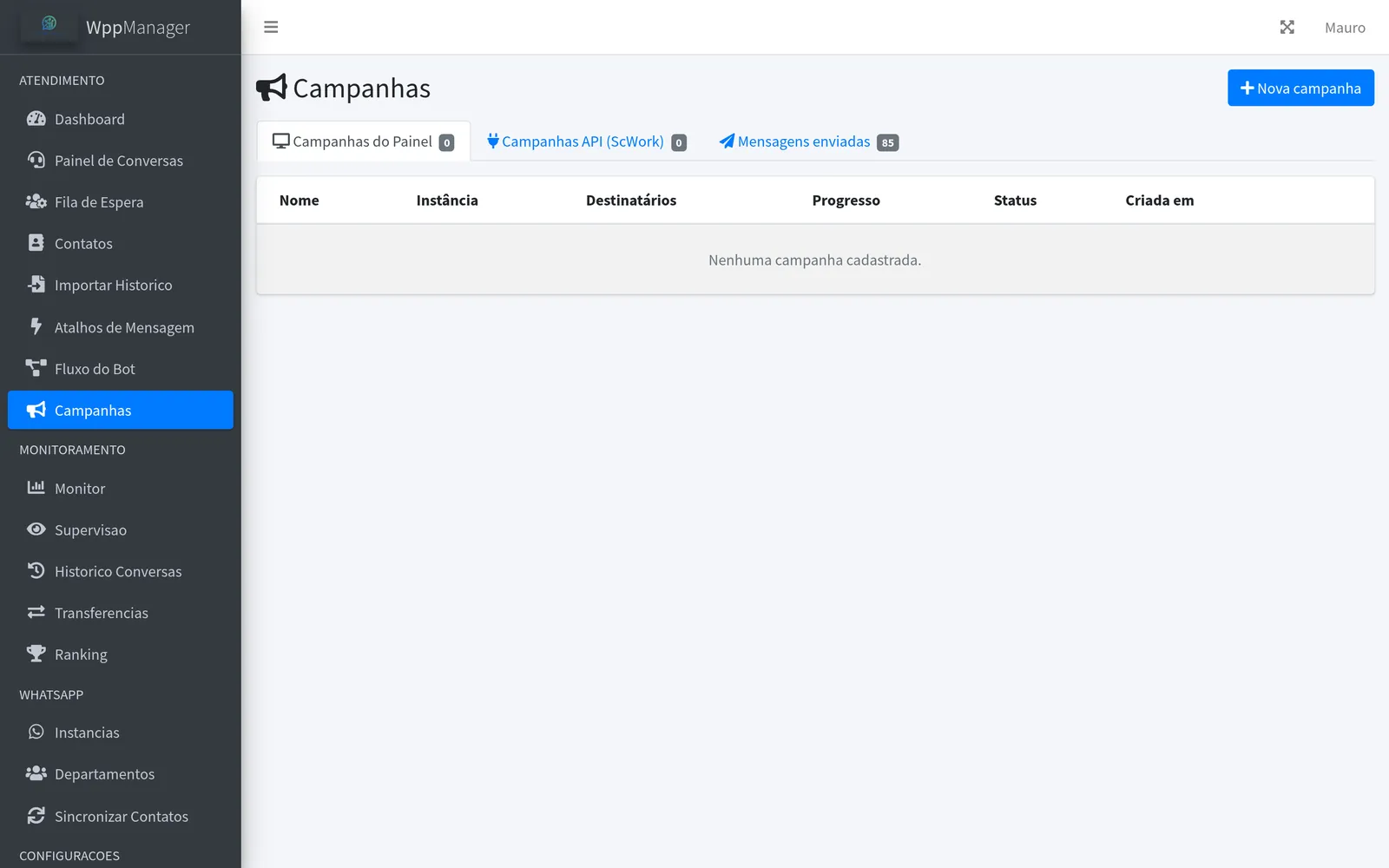
/admin/campanhas
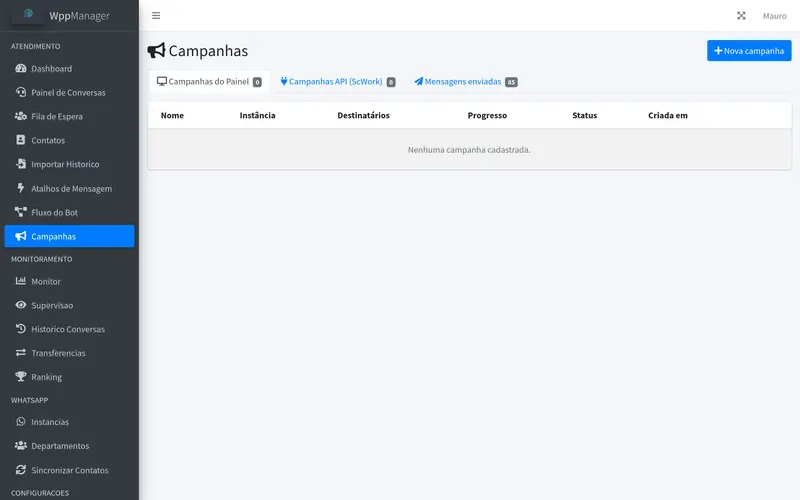
WppManager campaigns screen
Campaigns

Sending with control — not with crossed fingers

Hourly limit, interval between messages, automatic text variations and batch-by-batch tracking. You see who received it, who read it, who replied and who stayed silent.

  • Select by tag, by group expanded into members, or by CSV.
  • Variables such as {{nome}} and {{empresa}} in the message.
  • Duplicate a campaign and export the results to CSV.

And the system works to keep your number from being restricted. Anyone who has sent in bulk knows the risk isn't the message failing to go out — it's WhatsApp restricting the number afterward. That's why the safeguards aren't optional settings hidden on an advanced screen:

  • New numbers start slow. The daily cap rises with the number of days connected, instead of the first send going to your entire list.
  • Automatic brake. If messages start failing in a row, the campaign pauses itself and alerts you — instead of pushing on until the number is restricted.
  • Resend only to those who failed. Without touching those who already received it, which is exactly what turns a resend into spam.
  • Preview of who will receive it, with the option to remove contacts before sending — and an explicit warning when you choose to send to everyone again.

Real screens

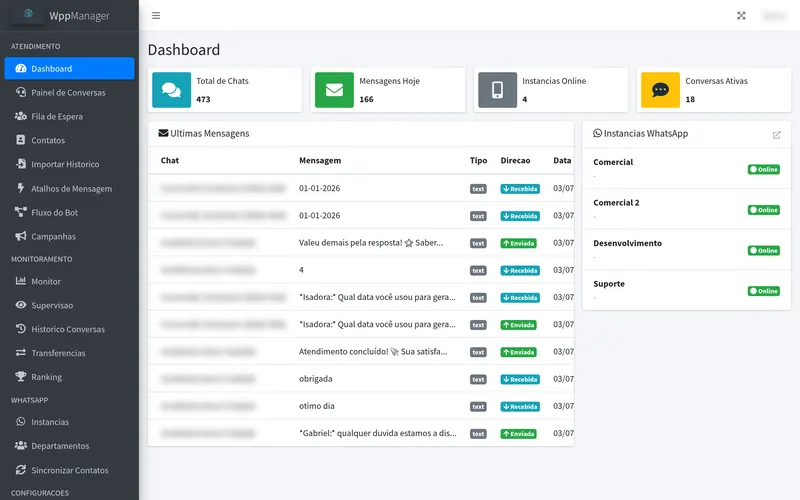
The dashboard running in production

Screenshots from the live environment, with names, phone numbers and conversation previews replaced by fictitious data. Click to enlarge.
Integration

Conversations that don't die in the chat

WppManager isn't an island. It asks CdAdm who's on the line, returns the document in the chat and logs the record in ScWork — without anyone typing anything twice.

How WppManager exchanges data with CdAdm and ScWork WppManager asks CdAdm who the number on the line belongs to and gets back the bank slip (boleto), invoice, PIX (Brazilian instant payment), pending items, owner payout and the VIP Area link. To ScWork it sends the lead with the suggested product, the ticket and the time spent on the conversation; and it receives campaign sends from ScWork. CdAdm also sends bank slips, owner payouts and invoices in bulk through WppManager, and the delivered and read confirmation flows back to the CdAdm grid. Below, the conversation with the customer on WhatsApp. CdAdm leases · finance portfolio · owner payouts WppManager bot · queue · service campaigns · supervision your company's WhatsApp ScWork CRM · help desk tasks · campaigns whose number is this? boleto · invoice · PIX pending items · payout · VIP Area lead · ticket · time WhatsApp campaign boleto · payout · invoice sent in bulk, through WppManager delivered · read flows back to the CdAdm grid Your customer on their usual WhatsApp The customer asks for a copy of the bill at 10 p.m. on a Sunday — and gets it with nobody on the other end. The next month, billing goes out in bulk — and the grid shows who read it.

How it works under the hood: the platform connects your numbers by QR code or pairing code, just like WhatsApp Web. Talk to us about volume and usage policy before planning large sends — we explain the limits frankly instead of promising unlimited sending.

Want to see it with your own numbers?

Build the scenario with us — how many numbers, how many agents — and get a firm quote, with no fine print. No lock-in contract and no cancellation fee, as with everything we sell.

Prefer to read it at your own pace or show it to your business partner? Download the PDF overview (in Portuguese) (8 pages, 1.6 MB).